Explore how early childhood art education fosters creativity, emotional regulation, and right-brain development. Discover practical strategies to nurture self-expression and problem-solving skills essential for the future.

Unlocking Infinite Potential: The Impact of Early Art Education in the Modern Era
In our rapidly changing world, children need more than just academic knowledge to thrive; they require adaptive skills. Early childhood art education plays a pivotal role in cultivating these crucial abilities. Most parents are aware that art activities like drawing and crafting benefit a child's creative development. However, its value extends far beyond that. Art becomes a unique language for children to understand the world and express themselves, expanding their thinking as they explore solutions to complex problems. For very young children, who may not yet articulate well verbally, art serves as a vital channel for conveying inner emotions and thoughts. This process fosters emotional stability, reduces fear of trying new things, and boosts self-esteem. It's not just about creating a beautiful end product; the very experience of independently thinking, feeling, and manifesting those ideas in various forms is essential nourishment for a child's holistic development. Cultivating flexible thinking and innovative problem-solving skills, which are paramount for the future, is profoundly supported by early childhood art education.

Core Methods of Art Education for Nurturing Creative Thinking
Art education significantly influences a child's brain development, particularly activating the right hemisphere. The right brain is responsible for non-linear thinking, including intuition, imagination, spatial perception, and pattern recognition. Art activities stimulate these right-brain functions, aiding balanced brain development. So, how should art education be approached? The key lies in 'process-oriented learning' and 'individualized approaches.' Rather than focusing on finding the 'right' answer or creating perfect forms, it's crucial to emphasize the child's process of freely exploring materials and experimenting with their own ideas. For instance, encourage children to create vastly different works even when given the same materials. Instead of asking 'What did you draw?' educators and parents should pose open-ended questions like 'What did you want to express?' or 'How does using this color make you feel?' Such questions prompt children to organize their thoughts verbally and deeply consider their methods of expression. Furthermore, providing a diverse range of materials (paints, clay, collage items, etc.) stimulates the senses and helps children naturally develop problem-solving skills as they explore the properties of new media.
※ This post contains affiliate links. I may earn a commission at no extra cost to you.

Practical Guide: Fostering Creativity Through Art Activities at Home
While specialized programs offer great benefits, you can certainly unlock the positive effects of early childhood art education right at home. The most crucial practical step is to create a 'free and accessible environment.' It's ideal to set up a space where your child can easily access art supplies whenever they feel inspired. For example, designate a corner in the living room with a small table and a variety of papers, crayons, washable markers, child-safe scissors, and glue. The important thing is to adopt an attitude of 'it's okay to make a mess' and respect your child's explorations. Creating an atmosphere where it's fine if paint gets on clothes or spills on the floor allows children to explore and express themselves freely, without fear of failure. When discussing their creations, focus on specific observations and questions rather than general praise like 'that's good.' Instead, try 'I notice you used this color, that's interesting,' or 'You made this shape, what story does it tell?' This acknowledges their thoughts and processes. Sometimes, engaging in nature-based art activities together can also be beneficial. Collecting leaves, pebbles, and flower petals to create unique artworks simultaneously fosters curiosity about nature and creativity. These activities help children perceive art as an enjoyable and free tool for self-expression.
Important Considerations and Age-Appropriate Approaches for Early Art Activities
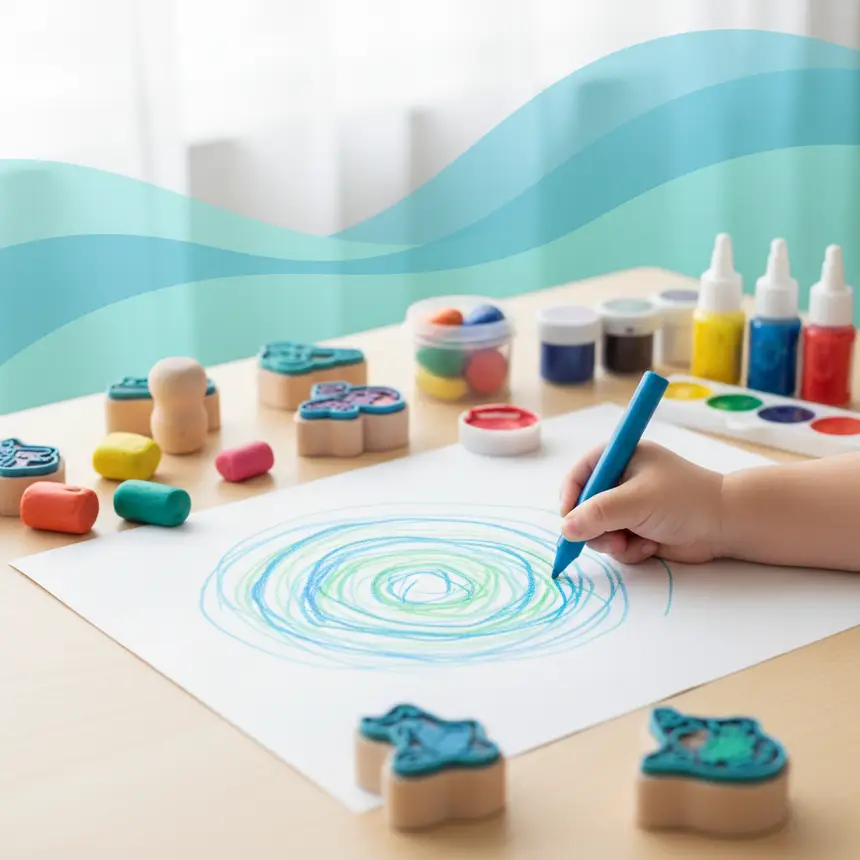
It's essential to tailor art activities to a child's developmental stage. Generally, children begin to grasp tools and scribble around 18 to 24 months. During this period, it's best to use safe crayons or washable paints, allowing them to freely draw lines and explore colors. The focus should be on enjoying the tactile sensations and the movement itself, rather than producing a specific outcome. Between ages 3 and 5, children start to explore more diverse materials, recognize shapes, and express their own ideas. At this stage, encourage their imagination with open-ended questions that have no 'right' answers, and applaud their attempts to mix or transform various materials. A crucial point of caution is to avoid evaluating a child's artwork or pointing out 'mistakes' from an adult perspective. Even if a child's drawing is abstract to adult eyes, it holds unique meaning and a story for them. The completeness of the final product is far less important than the child enjoying the art activity, expressing themselves freely, and gaining confidence in the process. Furthermore, encouraging them to tidy up after art activities can also be a valuable learning experience. Support your child to unleash their full potential through art in a safe and positive environment.
Frequently Asked Questions
Q. What is the most appropriate age to begin early childhood art education?
A. It's generally recommended to start when a child can hold a tool and begin scribbling, usually around 18-24 months. Focus initially on safe materials and letting them freely explore and enjoy the process.
Q. When doing art activities at home, what should parents prioritize the most?
A. Prioritize respecting your child's free expression and praising the process rather than just the outcome. Instead of 'What did you draw?', ask open-ended questions like 'What ideas did you want to express?' to encourage their thoughts.
Q. How specifically does art contribute to a child's emotional development?
A. Art activities provide an outlet for children to safely express emotions or thoughts they might find difficult to articulate verbally. This helps relieve stress, promotes emotional stability, and significantly contributes to self-understanding and self-esteem.
Q. What should I do if my child doesn't show interest in art activities?
A. Avoid forcing it. Instead, try changing up materials or themes to find something that might spark their interest. Incorporating natural elements or integrating art into play can also be effective. Showing your own enjoyment in art activities can also be encouraging.